

16 Year-Old Inventor of Halo Helmet Mask Discovers Reduced Need for Forehead Padding During On-Field Testing
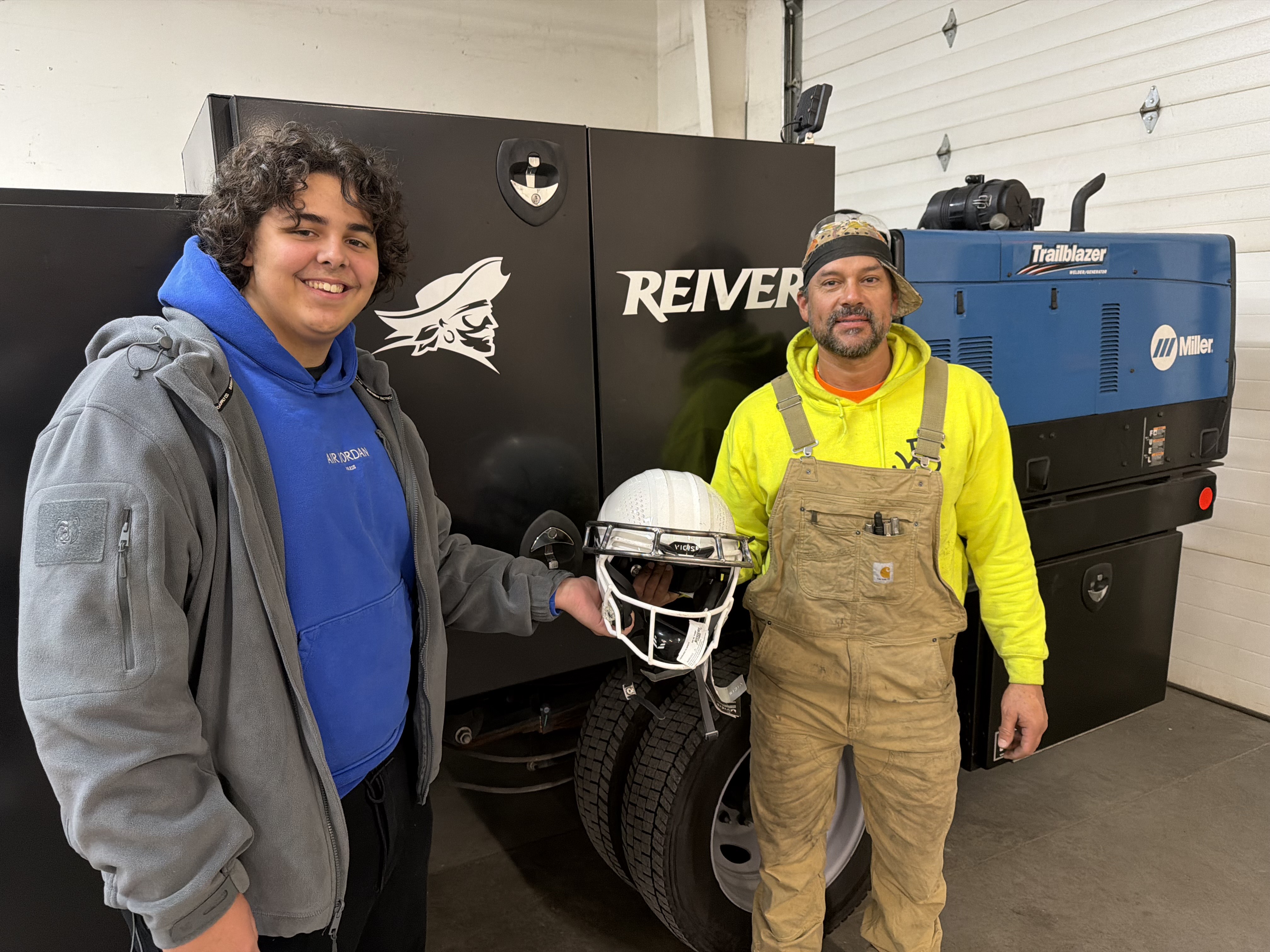
Halo Inventor Marist Veres Royal with Prototype Welder Chance Spradling at IWCC
Discovery Made in Preparation for Submission to Virginia Tech Helmet Lab this Week
The Bebop Channel Corporation (OTCMKTS:BBOP)
COUNCIL BLUFFS, IA, UNITED STATES, February 3, 2026 /EINPresswire.com/ -- Marist Veres Royal, inventor of the patent-pending Halo Protective Helmet Mask and a 6'4", 284-pound fullback/tight end attending Iowa Western Community College (IWCC)—who at age 16 holds the distinction of being the youngest player in NCAA football history—conducted live on-field testing yesterday in preparation for submitting the Halo to the Virginia Tech Helmet Lab this week for independent evaluation. During these tests, in a surprised discovery, Veres Royal determined that thick center-forehead padding may not be required in helmets incorporating the Halo device.
In standard helmets, thick forehead padding is necessary to cushion direct helmet-to-helmet impacts in frontal crashes. However, many players often find this padding, while essential for protection, creates uncomfortable constant pressure against the forehead. As a player who operates in the trenches—frequently engaging in direct, high-impact collisions as a blocker and ball carrier—Veres Royal's experience provided a unique perspective on frontal helmet forces.
This experience informed both the invention of the Halo and the recent observation that the device's unique deflection-based mechanism reduces residual force transmitted to the forehead during straight-on impacts. Specifically, the controlled backward force from the pull phase of its "push-pull" action (described below) does not travel far enough or apply sufficient pressure to necessitate thick center-forehead padding. This observation allows for a potential redesign of helmet interiors to include a second air gap -- the first between the Halo and the helmet's outer shell-- between the interior helmet shell and the center forehead, which could minimize compression and pressure sensations during impacts—addressing player discomfort from padding pressure while maintaining overall fit and stability.
The Halo Protective Helmet Mask features non-touching dual elliptical steel bars that deflect incoming force away from the helmet's front, directing residual energy to a rear steel plate (push phase), followed by a rigid counter-pull that draws the front back in a sequenced manner to reduce peak linear and rotational accelerations.
This finding does not alter the Halo design itself but represents an additional benefit observed when combined with helmet pad adjustments. It also supports criteria for patent approval of the non-provisional patent application filed in December 2025.
Veres Royal, who transferred to IWCC in January 2026 from Buffalo State as a freshman, collaborated with IWCC adjunct welding instructor Chance Spradling, who constructed the physical prototype. The enhanced Halo design is now being submitted to the Virginia Tech Helmet Lab for independent testing, with plans for subsequent discussions with helmet manufacturers.
According to Marist Veres Royal: "The controlled backward pull force of the helmet simply doesn't travel far enough to even reach the forehead. It feels like you're in a room."
Under the direction of the Halo’s Lead Consultant for Commercialization, former CBS/247Sports analyst Carl Reed Jr., testing at Virginia Tech is expected to provide further data on the device's performance in connection with Reed Jr.'s ongoing discussions with helmet manufactures.
About The Halo Protective Helmet Mask's Push-Pull Action
The Halo's "push-pull" concept refers to its sequenced force management during straight-on impacts. Incoming force is first deflected by the non-touching elliptical bars, then directed rearward to the back steel plate (the "push" phase). The rigid bar structure then creates a controlled counter-force that draws the front of the helmet backward toward the impact zone (the "pull" phase). This extends the duration and path of force transmission, reducing peak velocity, acceleration, and rotational effects on the head compared to direct helmet-to-helmet crashes.
GREGORY CHARLES ROYAL
The BeBop Channel
+1 917-721-7421
email us here
Visit us on social media:
YouTube
X
Halo Helmet Mask Test Live Hit with Marist Veres Royal and Chance Spradling IWCC
Legal Disclaimer:
EIN Presswire provides this news content "as is" without warranty of any kind. We do not accept any responsibility or liability for the accuracy, content, images, videos, licenses, completeness, legality, or reliability of the information contained in this article. If you have any complaints or copyright issues related to this article, kindly contact the author above.
